
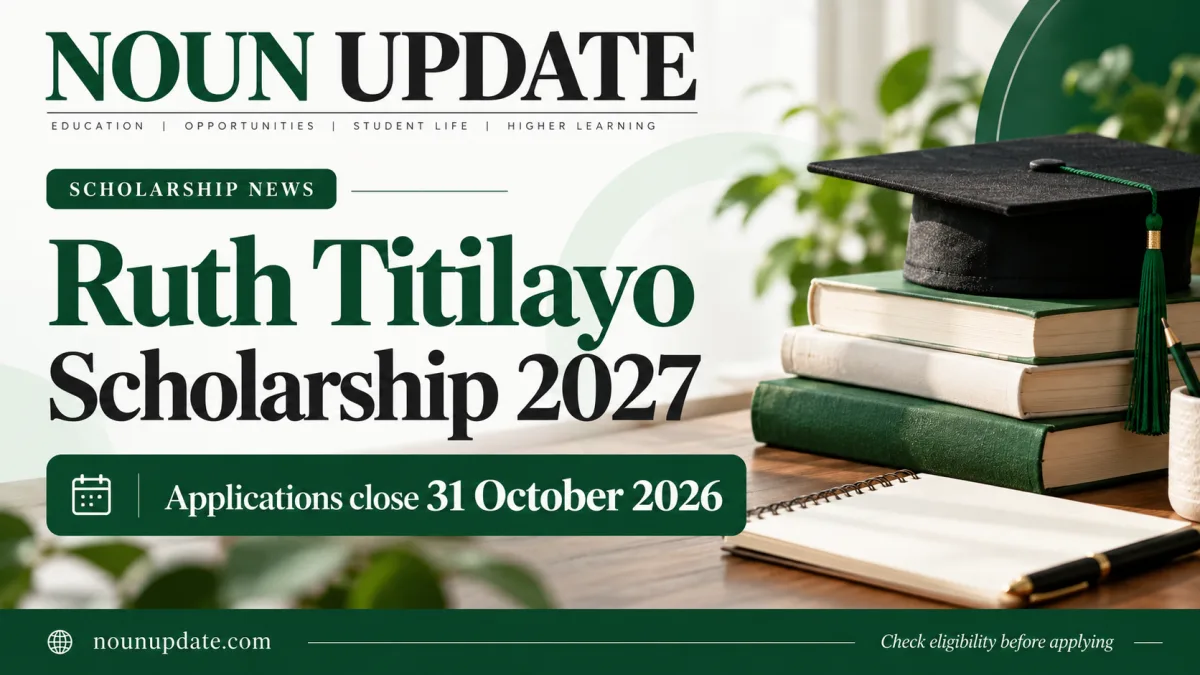
The Ruth Titilayo Educational Foundation is accepting applications for its 2027 undergraduate scholarship, with submissions closing on 31 October 2026.
The scheme targets learners at Nigerian federal and state universities. Published requirements include residence in Nigeria, an age below 25 and a minimum GPA of 4.0 on a five-point scale or its equivalent. Applicants must currently be students or have been registered within the preceding three years; final-year undergraduates are included.
Support comprises a tuition allowance of up to ?100,000 and maintenance assistance of up to ?20,000. Other allowances are discretionary. These figures are maximum amounts, not guaranteed payments to every applicant.
For NOUN students, an important eligibility question remains unresolved: the published conditions do not explicitly explain whether open and distance-learning enrolment qualifies. Prospective applicants should obtain clarification from the foundation at undergrad.grants@ruthtitilayofoundation.org before treating the opportunity as confirmed for their study mode.
A useful enquiry should identify NOUN, the applicant’s programme and level, and ask directly whether distance learners can be considered. Avoid sending sensitive identity documents with an initial eligibility question.
The official application form? requests personal and academic information, including university, course, level, GPA and current school fees. Applicants should ensure these entries agree with their records and review the form’s data-processing consent before submitting.
The foundation says successful applicants will subsequently be asked for academic results, two tutor references, a personal statement and supporting documents.
Students can prepare by checking that their latest result is available, identifying suitable academic referees and drafting a clear account of their educational goals. Keep the statement factual: explain what you study, the financial difficulty you face and how support would help you continue.
Submit through the foundation’s website and retain any acknowledgement. Do not misstate your institution or study mode if a form option is missing; seek guidance instead.
Applicants should also be cautious of intermediaries promising selection or requesting payment to reserve an award. A scholarship application is not an award confirmation, and students should continue planning for their expenses while awaiting an official decision.