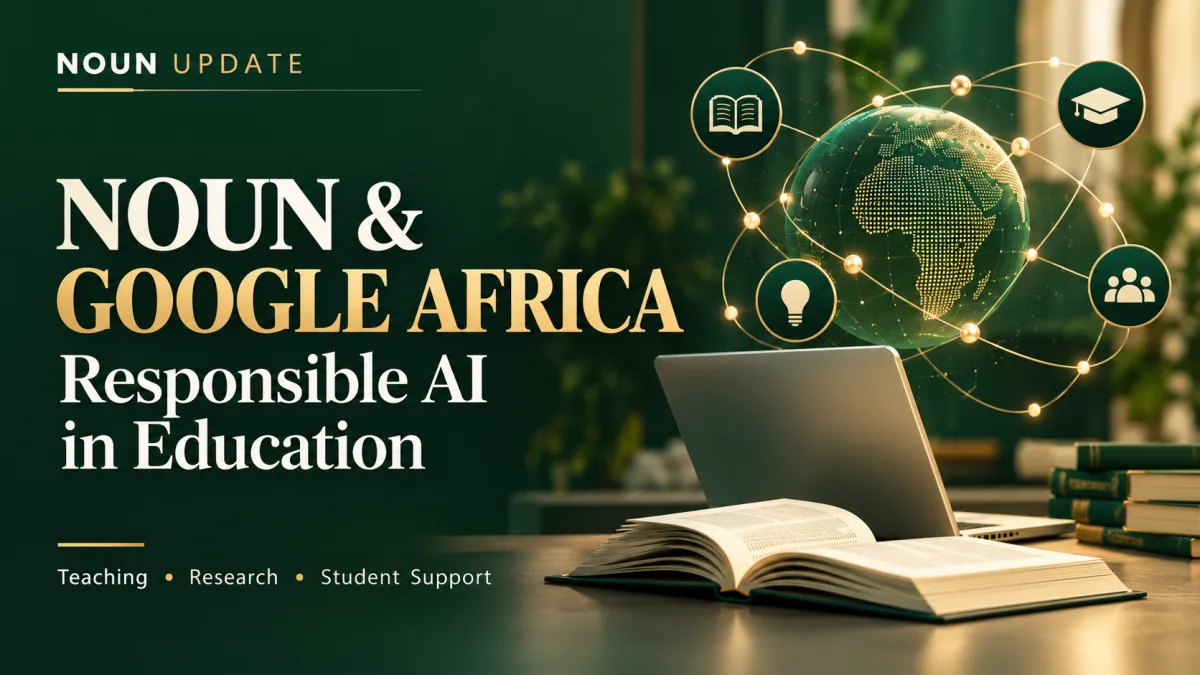
The National Open University of Nigeria has strengthened its collaboration with Google Africa for Education through a two-day workshop on the practical use of generative artificial intelligence in teaching, learning, research and student support.
Organised by the university’s Directorate of Information and Communication Technology, the workshop opened on Friday, 16 October 2026.
Vice-Chancellor Professor Uduma Oji Uduma, represented by Deputy Vice-Chancellor for Technology, Innovation and Research, Professor Christine Ofulue, emphasised that AI should enhance human expertise.
He disclosed that NOUN had developed an AI policy following workshops with UNESCO. The policy guides academic and administrative applications and undergoes review as technologies evolve.
Google for Education’s Higher Education Lead for West and Central Africa, Emmanuel Adeniyi, presented Gemini for Education and stressed the importance of human judgement.
DICT Director, Dr Francis Osang, said the training aimed to equip faculty members with practical skills for incorporating Gemini into their academic workflows.
NOUN reported more than 160,000 registered students for the 2026_2 semester and over 125 study centres. The announcement did not provide a university-wide student-access timetable or new assessment instructions.
Potential implications for distance learning
For a university built around open and distance education, the significance of AI adoption extends beyond introducing another digital tool. Its value will depend on whether it helps students understand course content, obtain reliable assistance and navigate academic services more effectively.
Possible applications include helping educators prepare explanations at different levels of difficulty, develop revision exercises and organise learning resources. Administrative applications could also help staff locate information and respond to recurring enquiries.
These are potential uses rather than confirmed services available to every NOUN student. Their effectiveness would depend on the quality of the information supplied to the system, staff oversight and regular checks for errors.
Students studying independently may benefit from additional explanations outside scheduled academic interactions. However, an inaccurate automated response could also create confusion, especially when it concerns examination requirements, course registration or project submissions.
Academic responsibility remains central
The growing use of generative AI raises practical questions about the boundary between learning assistance and work submitted for assessment.
A tool that explains a difficult concept can support understanding. Using generated content without checking its accuracy, sources or compliance with course instructions can create problems for the student submitting it.
Students should seek guidance from their lecturers or supervisors where permitted AI use is unclear. References suggested by an AI system should be checked against the original publications, while calculations and factual claims should be compared with course materials and reliable sources.
Access and privacy require clear guidance
Google describes Gemini for Education as an institution-managed service with education-specific data protections. Its privacy guidance states that users signed into Google Workspace for Education accounts receive protections against their data being used to improve AI models. These statements do not establish whether individual NOUN student accounts have been enabled for access.
For students, clear institutional guidance on account access, permitted activities and confidential information will be important as adoption develops. Research participants’ personal details, passwords and restricted academic records should be handled through approved processes.
The practical measure of the initiative will be how staff training translates into accurate, accessible learning resources and dependable student support.
Source: NOUN News: NOUN VC Backs Ethical AI Integration in Google Partnership, published 16 October 2026